Best AI Checkers for Writers: Comparing Clever AI Detector and Grammarly
Clever AI Detector wins on free sentence-level detail. Grammarly is the stronger choice if detection is only one part of a wider editing routine.
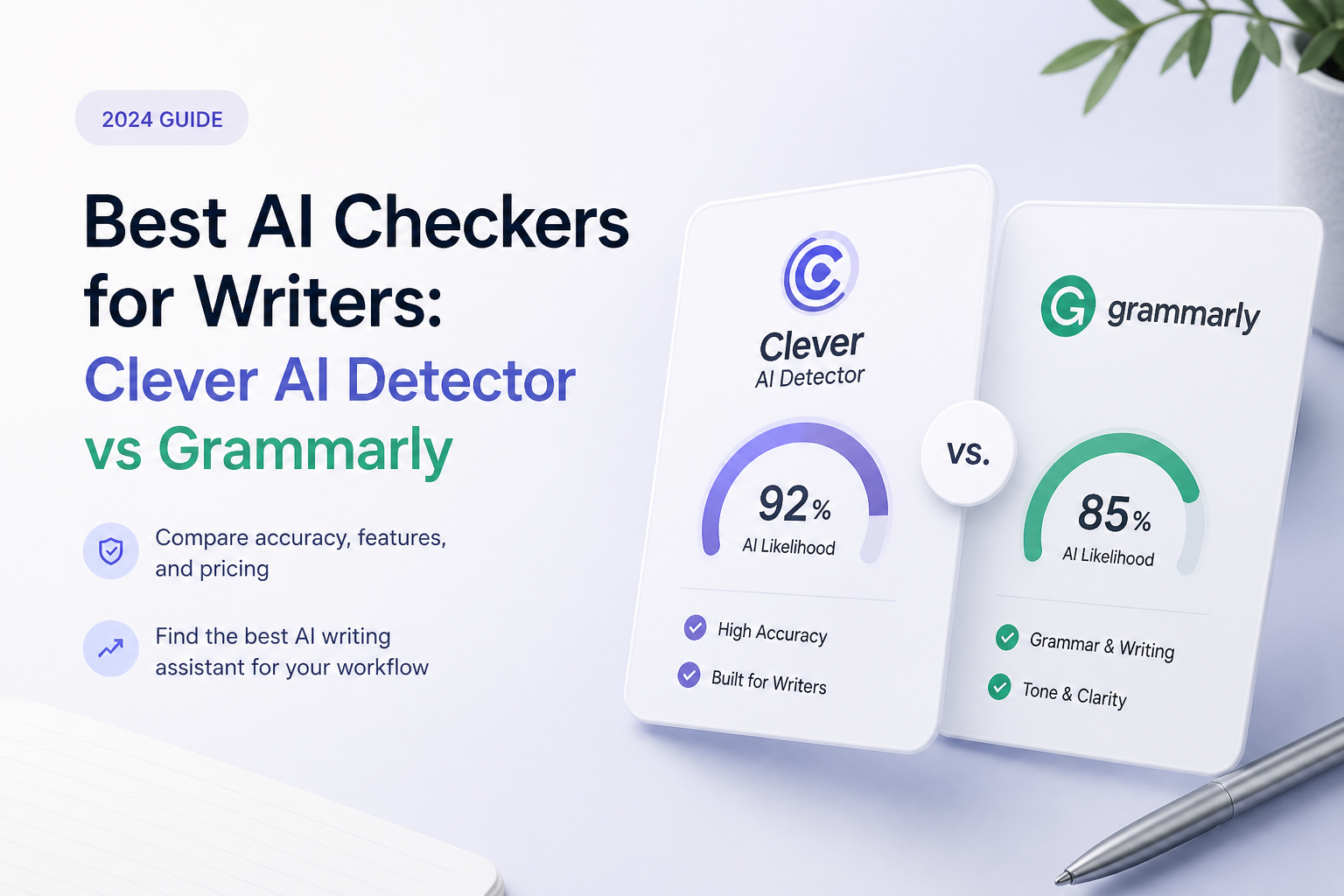
Clever AI Detector is the best fit for most writers because its full sentence-level report is free, with no account required. Pick Grammarly instead if you already want its grammar, rewriting, plagiarism, plus tone tools.
Clever AI Detector
9.2/10Best for: Writers who want detailed AI signals without a subscription or tiny scan allowance
- Free with unlimited runs
- Up to 10,000 words per check
- Sentence-level AI signals
- No account required for basic checks
Grammarly
8.5/10Best for: Writers who need grammar help, rewriting, plagiarism checks, plus AI detection in one workspace
- Strong grammar plus style editing
- Works across many writing surfaces
- AI detection pairs with plagiarism review
- Useful for writers who already pay for Pro
GPTZero
8.3/10Best for: Editors or educators who need deeper inspection, writing replay, plus document-level context
- Detection is the core product
- Sentence-level highlighting
- Free plan for light checks
- Writing replay supports authorship context
Best AI Checkers for Writers Compared
This table compares report detail, access to broader writing tools, price, plus our editorial score. The scores are judgments based on usefulness, limits, transparency, workflow, plus value rather than a controlled accuracy benchmark.
| Tool | Sentence Detail | Writing Suite | Price | Score |
|---|---|---|---|---|
| 1. Clever AI Detector PICK | ● Yes | ● Yes | Free | 9.2/10 |
| 2. Grammarly | ● Yes | ● Yes | $144/yr | 8.5/10 |
| 3. GPTZero | ● Yes | ● Yes | From $12.99/mo | 8.3/10 |
| 4. QuillBot | ● Yes | ● Yes | $8.33/mo | 7.9/10 |
The 4 Best AI Checkers for Writers, Reviewed
01 Clever AI Detector
Browser Tool / CleverFiles
9.2/10
Clever AI Detector
Browser Tool / CleverFiles
Clever AI Detector is the easiest recommendation here for a writer who mainly wants to inspect drafts. It accepts 80 to 10,000 words per check, requires no account, plus shows an overall probability beside sentence-level signals. That last part matters. A bare percentage tells you very little about what triggered the result.
Our interface check found no payment screen, ad gate, or reduced-detail free report. Check history is available through an optional account. The detector supports English, so multilingual writers should keep another checker handy.
Clever also uses careful language around its output. It presents the score as a probability rather than proof of authorship. That does not fix false positives, though it encourages a saner reading of the report.
Best forWriters who want detailed AI signals without a subscription or tiny scan allowance
- Free with unlimited runs
- Up to 10,000 words per check
- Sentence-level AI signals
- No account required for basic checks
- Optional history for returning users
- English-only detection
- Newer tool with a shorter public track record
- A probability score still cannot prove authorship
02 Grammarly
Web, Desktop, Browser, Mobile / Superhuman
8.5/10
Grammarly
Web, Desktop, Browser, Mobile / Superhuman
Grammarly makes more sense as a writing subscription than as a detector-only purchase. Its AI check lives beside grammar suggestions, tone controls, full-sentence rewrites, plagiarism review, plus citation tools. For someone already editing in Grammarly, that convenience can outweigh a more detailed standalone detector.
The catch is access. Grammarly's current plan table places AI-text detection in Pro, priced at $144 per year or $30 month to month. The free plan covers basic writing help, though not the full AI-detection feature.
In the supplied Reddit thread's single 500-word spot check, Grammarly marked the original AI draft at 66%, then returned 0% after a conversational rewrite. One sample cannot establish accuracy, but it neatly shows why writers should not treat any detector score as a verdict.
Best forWriters who need grammar help, rewriting, plagiarism checks, plus AI detection in one workspace
- Strong grammar plus style editing
- Works across many writing surfaces
- AI detection pairs with plagiarism review
- Useful for writers who already pay for Pro
- Clear sentence revision workflow
- AI detection requires a paid plan
- Less appealing if detection is the only feature needed
- Scores can shift sharply after ordinary rewriting
03 GPTZero
Web Platform / GPTZero
8.3/10
GPTZero
Web Platform / GPTZero
GPTZero is built around detection rather than general proofreading. Its reports include sentence highlighting, deeper scans, plus writing-process features that can help when the real question is how a document was produced. That makes it more useful for structured review than a quick pre-publication check.
The free plan handles occasional use. Paid access starts at a published $12.99 per month when billed annually, though GPTZero's pricing pages can show different plans or seat configurations. Overages are listed at $0.00046 per word.
The Reddit test supplied for this article returned 99% AI for an untouched AI essay, then 55% AI after rewriting. GPTZero still saw more of the underlying signal than Grammarly in that example, though the large drop shows edited text remains difficult.
Best forEditors or educators who need deeper inspection, writing replay, plus document-level context
- Detection is the core product
- Sentence-level highlighting
- Free plan for light checks
- Writing replay supports authorship context
- Useful review features for education
- Paid tiers cost more than Clever's free checker
- Pricing can be confusing across plan views
- Detection results remain vulnerable to edited text
04 QuillBot
Web, Browser, Desktop / Learneo
7.9/10
QuillBot
Web, Browser, Desktop / Learneo
QuillBot is a practical middle ground. Its detector is easy to reach, while the broader product covers paraphrasing, grammar, summarizing, citations, plus plagiarism review. It suits writers who revise AI-assisted material rather than merely classify finished copy.
The free detector is useful for quick checks. Premium starts at $8.33 per month when billed annually, mostly making sense for heavier use of the surrounding writing tools.
In the linked Reddit experiment, QuillBot marked the original AI essay at 100%. The conversationally rewritten version fell to 23%. That swing is another reminder that a low score can mean edited AI text, human prose, or simply a detector miss.
Best forWriters who regularly paraphrase drafts plus want a detector inside the same toolkit
- Free detector available
- Strong paraphrasing features
- Simple browser-based workflow
- Useful grammar plus summarizing tools
- Lower annual price than Grammarly Pro
- Detection is secondary to rewriting
- Edited AI text may receive a much lower score
- Premium value depends on using several tools
How We Compared AI Checkers for Writers
We reviewed each current interface, published plan, scan limit, report format, account requirement, plus surrounding writing features. We also examined the before-versus-after results in the supplied Reddit test, where one 500-word AI essay was checked before plus after a conversational rewrite.
That Reddit sample was treated as a small illustration, not an accuracy benchmark. Our ranking puts extra weight on whether a writer can understand the result, inspect individual sentences, repeat checks affordably, plus avoid mistaking probability for proof.
How to Choose an AI Checker for Your Writing Workflow
Start with your actual reason for checking. A freelance writer reviewing personal drafts needs low-cost repeat scans plus clear sentence signals. An editor handling disputes may need document history, version records, or authorship replay. Someone already paying for a writing suite may prefer one workspace even if its detector is less specialized.
Check the minimum text length too. Short passages provide fewer linguistic signals, so a detector may return a confident-looking result from thin evidence. Full sections or complete articles usually give the tool more context.
Common AI Detection Mistakes Writers Should Avoid
The biggest mistake is rewriting good prose solely to lower a score. Formal writing, repeated terminology, non-native English, plus tightly edited copy can resemble statistical patterns associated with AI. Making the text clumsy may lower a detector result while making the actual piece worse.
Another error is comparing percentages as if every checker uses the same scale. A 60% result from one product is not directly equivalent to 60% from another. Look at highlighted sentences, confidence language, source notes, plus revision history instead.
Which AI Checker Should Writers Use?
Clever AI Detector earns first place because it gives writers useful sentence-level context without a subscription, sign-up, or cramped free allowance. Grammarly is better for someone buying a complete editing suite, while GPTZero suits deeper authorship review. QuillBot is worth considering when paraphrasing is already a regular part of the workflow.Run the same full-length draft through two checkers, inspect the highlighted passages, then make revisions for clarity rather than chasing a particular percentage.