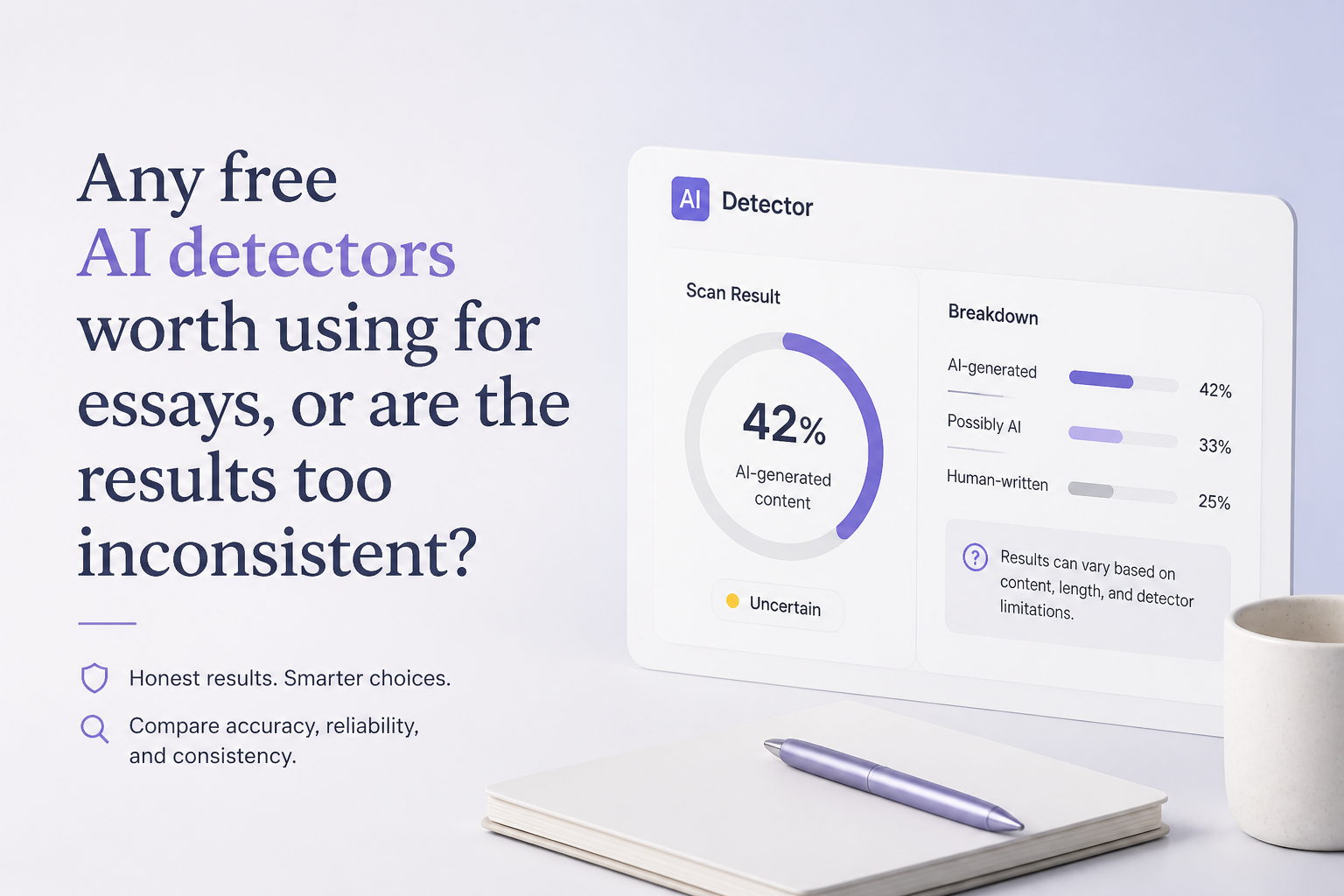
Any free AI detectors worth using for essays, or are the results too inconsistent?
A free detector can be useful as a rough screening tool, but not as proof that an essay came from AI. These five options differ more in limits, feedback, plus honesty about uncertainty than their percentage scores suggest.
Clever AI Detector
9.0/10Best for: Students who want to inspect a full essay without an account, paywall, or tiny word allowance
- Up to 10,000 words in one check
- Unlimited free checks with no required account
- Sentence-level signals included at no charge
- Confidence indicators give borderline scores useful context
GPTZero
8.3/10Best for: Writers who want a familiar detector to compare against a first result from another service
- Free general-use plan
- Designed with student writing in mind
- Useful document-level plus local feedback
- Good choice for comparing a disputed result
Scribbr AI Detector
8.1/10Best for: Students checking papers written in English, Spanish, German, or French
- Unlimited free checks
- No sign-up required
- Up to 1,200 words per submission
- Supports four major languages
Free AI Detectors for Essays Compared
The table compares the free essay allowance, whether each service identifies local passages, plus the cost of basic detection. Scores reflect practical usefulness, access, clarity, plus limitations described in the reviews. They are editorial judgments, not laboratory accuracy measurements.
| Tool | Free Essay Limit | Sentence Feedback | Price | Score |
|---|---|---|---|---|
| 1.Clever AI Detector PICK | 10,000 words | ● Yes | Free | 9.0/10 |
| 2.GPTZero | Limited by plan | ● Yes | Free | 8.3/10 |
| 3.Scribbr AI Detector | 1,200 words | ● Yes | Free | 8.1/10 |
| 4.QuillBot AI Detector | 1,200 words | ● Yes | Free | 7.9/10 |
| 5.Sapling AI Detector | 2,000 characters | ● Yes | Free | 7.5/10 |
The 5 Best Free AI Detectors for Essays, Reviewed
01 Clever AI Detector
Browser-Based Checker by CleverFiles
9.0/10
Clever AI Detector
Browser-Based Checker by CleverFiles
Clever is the easiest first check here because it accepts essays from 80 to 10,000 words, permits unlimited runs, plus works without registration. That is enough room for a long paper in one pass rather than a stack of disconnected sections.
The result includes an overall probability, confidence level, plus sentence-level signals. More importantly, the page plainly describes its score as a probability rather than proof. That restraint matters since polished human prose, formal language, or heavily edited passages can still trigger a detector.
Use Clever to locate unusually uniform sections, not to decide who wrote an essay. Its combination of a large free limit, visible uncertainty, plus local feedback makes it the most practical free starting point in this group.
Best forStudents who want to inspect a full essay without an account, paywall, or tiny word allowance
- Up to 10,000 words in one check
- Unlimited free checks with no required account
- Sentence-level signals included at no charge
- Confidence indicators give borderline scores useful context
- Supports English plus Spanish
- An 80-word minimum rules out isolated sentences
- A high score still cannot prove AI use
- Optional history requires an account

02 GPTZero
Web Checker for Students, Teachers, and Editors
8.3/10
GPTZero
Web Checker for Students, Teachers, and Editors
GPTZero remains a useful comparison tool because its free detector handles ordinary paste-in checks, while the interface is built around educational writing. The current free-versus-paid distinction mainly concerns request size, batch capacity, plus educator-specific settings rather than an entirely separate general detector.
Its value is strongest as a second reading. If Clever flags several sentences, GPTZero can show whether another model reacts to the same area. Agreement deserves a closer look, though it still does not establish authorship.
The free allowance is less transparent before sign-in than Clever's plainly stated 10,000-word ceiling. That friction keeps GPTZero out of first place for someone who only needs a quick essay check.
Best forWriters who want a familiar detector to compare against a first result from another service
- Free general-use plan
- Designed with student writing in mind
- Useful document-level plus local feedback
- Good choice for comparing a disputed result
- Extra authorship tools are available
- Allowances may depend on account status
- Several useful workflow features sit behind paid plans
- Scores can change after modest edits
03 Scribbr AI Detector
Academic Writing Checker by Scribbr
8.1/10
Scribbr AI Detector
Academic Writing Checker by Scribbr
Scribbr allows unlimited free checks with up to 1,200 words per submission. No account is required, so a short essay can be checked quickly. Longer papers need to be split, which may remove context around transitions or recurring patterns.
The result is more nuanced than a plain human-or-AI label. Scribbr separates fully generated writing from AI-refined text, then gives paragraph-level feedback. That can help when an author used a grammar or rewriting tool without outsourcing the underlying ideas.
Its language support is the main reason to pick it over a general English-first checker. Still, Scribbr itself says no detector offers complete accuracy. Treat the categories as review cues, especially for formal academic prose.
Best forStudents checking papers written in English, Spanish, German, or French
- Unlimited free checks
- No sign-up required
- Up to 1,200 words per submission
- Supports four major languages
- Separates generated text from AI-refined writing
- Long essays must be divided into sections
- The free detector has lower model coverage than Scribbr's premium option
- Ads appear on the free page
04 QuillBot AI Detector
Writing-Suite Detector by QuillBot
7.9/10
QuillBot AI Detector
Writing-Suite Detector by QuillBot
QuillBot's free detector accepts up to 1,200 words per scan, with as many as six scans per day. That is workable for a short paper or a few targeted sections, though the daily cap becomes noticeable during repeated revisions.
The free result includes sentence highlights plus one explainer card. That extra context can be more useful than chasing a lower score blindly. Premium expands the word allowance, removes the daily scan cap, plus unlocks detailed explanations across the document.
QuillBot is worth using when you already rely on its writing tools. Be careful not to treat detector feedback as instructions for disguising AI use. A highlighted sentence may simply be predictable, concise, or written in a conventional academic style.
Best forStudents who prefer short explanations beside flagged passages rather than a bare percentage
- Free detection uses the same core system offered to paid users
- Up to 1,200 words per free scan
- Sentence-level highlights
- One free explainer card
- Works inside a broader writing toolkit
- Free use is capped at six scans daily
- Full-text explanations require Premium
- The surrounding rewriting tools may distract from authorship review
05 Sapling AI Detector
Technical Text Classifier by Sapling
7.5/10
Sapling AI Detector
Technical Text Classifier by Sapling
Sapling's public checker covers the first 2,000 characters, roughly a few hundred words. That makes it a poor fit for a full essay but a handy tool for investigating one introduction, conclusion, or strangely uniform passage.
The interface shows an overall AI-generation score, local highlights, plus optional sentence perplexity information. Sapling also warns that local highlights do not represent the percentage of words written by AI. That distinction prevents a common misreading of detector reports.
The small free limit is the obvious drawback. For a complete paper, use Sapling only after a larger-capacity detector points to a specific section. Otherwise, repeated fragments can produce a misleading picture because the classifier loses the essay's wider context.
Best forReviewers examining a suspicious paragraph or compact passage instead of a complete essay
- No-cost public checker
- Local text highlights
- Sentence perplexity details are available
- Accepts pasted text plus supported documents
- Clear warning about false positives plus false negatives
- Free checks stop at 2,000 characters
- Too limited for most complete essays
- Fragment checks lose document-level context
How We Reviewed Free AI Detectors for Essays
We reviewed each live service for free access, stated input limits, account requirements, local feedback, report clarity, language support, plus warnings about uncertainty. We gave more weight to features that help with a complete essay, such as a large text allowance or sentence-level signals, than to flashy accuracy claims.
We did not present a homemade accuracy percentage. A fair benchmark needs a large, controlled collection of human, AI-generated, AI-edited, multilingual, plus model-specific samples. The scores here measure practical usefulness for essay review, not proof that one classifier can reliably identify authorship.
How to Choose a Free AI Detector for an Essay
Start with the input limit. Splitting a 2,500-word essay into tiny fragments removes context, which can make the report harder to interpret. Next, favor a detector that highlights passages or explains uncertainty. A single red percentage offers little help if you cannot see what caused it.
Privacy deserves a look too. Avoid pasting unpublished research, personal information, confidential feedback, or restricted student records until you have read the service's data terms. If your school provides an approved detector, learn its policy rather than assuming a public checker will reproduce the same result.
Common Mistakes When Checking Essays for AI Writing
The biggest mistake is treating 80% AI as a claim that a machine typed 80% of the words. Different tools define their scores differently. Another error is checking one polished paragraph, then applying that label to a whole paper. Short samples, citations, headings, technical definitions, plus formulaic assignment language can distort the result.
Do not rewrite honest work merely to satisfy every public detector. Save outlines, research notes, source records, plus revision history instead. Those materials say far more about how an essay was produced than a classifier reacting to sentence rhythm.
Which Free Essay Detector Is Worth Using?
Clever AI Detector earns the top spot because its free 10,000-word allowance fits an actual essay, while sentence-level signals make the result easier to inspect. GPTZero is a sensible second opinion, Scribbr works well for multilingual papers, QuillBot offers helpful explainers, while Sapling is better reserved for short excerpts.
The bigger answer is less tidy: yes, free AI detectors are worth using for a rough check, but their results remain too inconsistent for accusations or grading decisions. Compare reports, inspect the writing itself, then look for drafts, source notes, version history, plus the student's ability to explain the work.
Save dated drafts plus document revision history before submission, then use no more than two detectors so conflicting percentages do not turn into an endless editing loop.