Clever AI Detector Accuracy Test: Full Results
Clever AI Detector performed unusually well on edited, rewritten, plus humanized AI text. The results are promising, though the benchmark covers one narrow type of English essay.
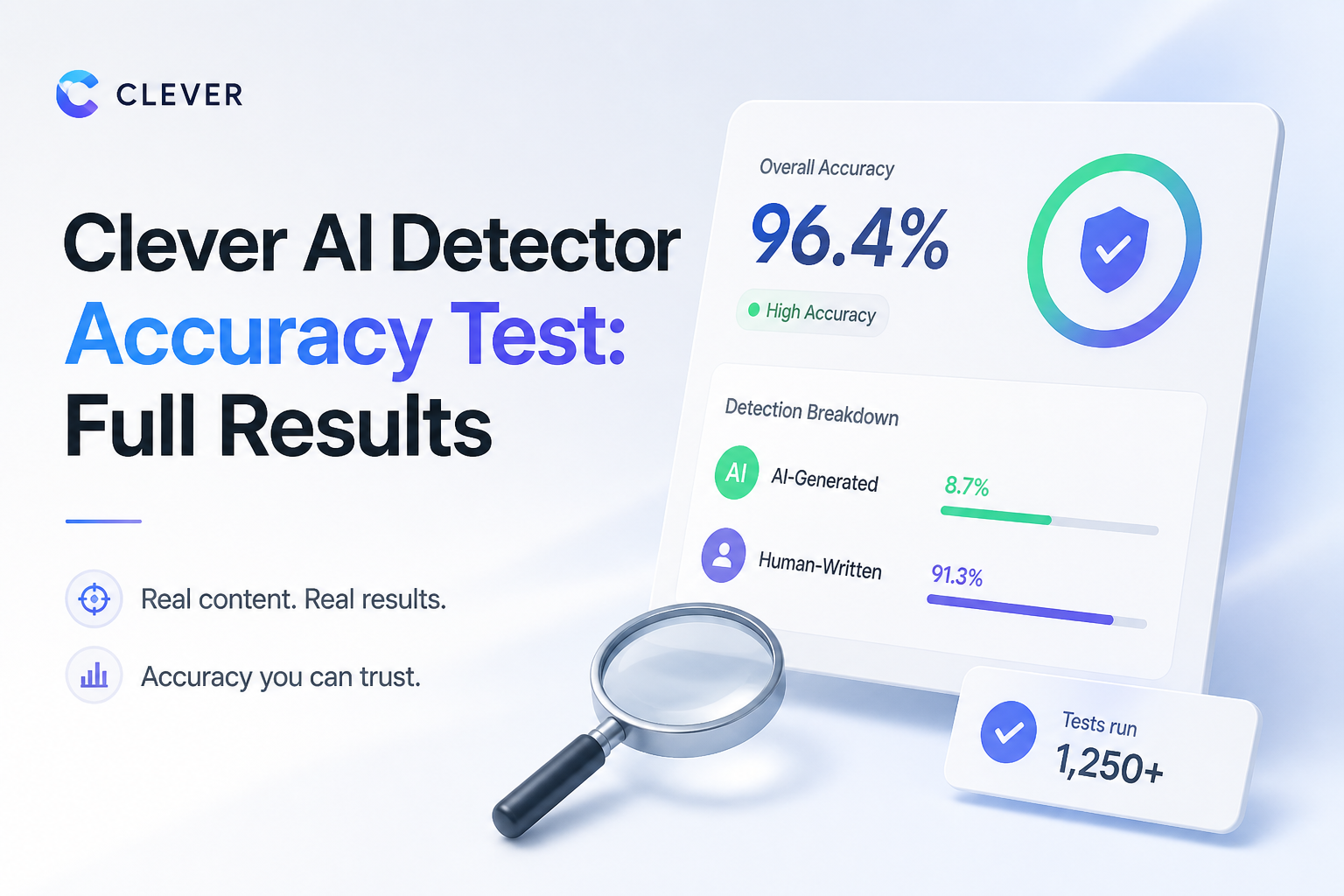
Clever AI Detector caught 580 of 600 AI-involved essays in its published August 2026 benchmark, including 92% of adversarially humanized samples. It is free, requires no account, plus accepts up to 10,000 words per check. The main caution is simple: this was one English-language essay corpus, not proof that every future result will be right.
Clever AI Detector at a Glance
9.2/10Clever AI Detector is a browser-based checker that estimates the probability of AI involvement in a passage. It also marks sentence-level signals so readers can inspect the result rather than relying only on one number.
Best forEditors, teachers, publishers, plus writers who need a quick second opinion on medium or long English text
- Overall AI probability score
- Sentence-level AI signals
- Confidence indicators
- File upload plus pasted-text checks
- History for signed-in users
- Strong results on edited AI text
- No signup needed
- Clear uncertainty disclaimer
- Test corpus focused on English student essays
- A score cannot prove authorship
- Short passages need extra caution
How We Evaluated Clever AI Detector Accuracy
We reviewed Clever’s August 2026 benchmark at the category level rather than repeating the company’s headline ranking. The test used 750 texts from the public GEDE research corpus: 150 direct AI essays, 150 AI-improved human drafts, 150 machine-rewritten human drafts, 150 humanized AI essays, plus 150 pre-ChatGPT human controls. Each sample was checked by eight detectors.
Our review score weighs recall on difficult text most heavily, followed by false-positive evidence, report clarity, input limits, plus price. We also reduced the score slightly because the vendor tested its own detector, the controls covered one narrow genre, plus the first 150 texts in each category were used instead of a random sample.
When Clever AI Detector Should Not Decide the Outcome
Do not use one Clever score to accuse a student, reject a writer, or cancel a contract. A detection result describes patterns in the submitted text. It does not reveal the document’s author, research process, editing history, or permitted use of grammar tools.
It is also a poor fit for tiny snippets, confidential material that cannot be uploaded, code, poetry, or languages outside the tested English corpus. In those cases, ask for revision history, compare earlier samples, plus discuss the work directly.
Clever AI Detector: Accuracy Scores Across Five Review Categories
| Category | Performance | Score |
|---|---|---|
| 01 AI Detection Accuracy | 9.7/10 | |
| 02 Edited Text Detection | 9.4/10 | |
| 03 Result Clarity | 9.1/10 | |
| 04 Everyday Usability | 9.3/10 | |
| 05 Free Access | 9.8/10 |
Clever AI Detector Accuracy Results in Detail
01 AI Detection Accuracy
Very high recall across the published essay corpus
9.7/10
AI Detection Accuracy
Very high recall across the published essay corpus
The headline result is 96.7% recall. Clever AI Detector identified 580 of the 600 essays labeled as AI-involved, missing 20. Six competing detectors were tested on the same texts, plus Copyleaks, giving the result more context than a simple human-versus-raw-ChatGPT demo.
It caught 100% of directly generated essays. That particular result is less remarkable because six of the eight detectors also reached 100%. Clever’s real strength appeared after the source text had been edited, rewritten, or deliberately paraphrased.
- Caught 580 of 600 AI-involved essays
- Reached 100% on direct AI output
- Used a public research corpus
- Published category-level results rather than one broad claim
- The company ran the comparison featuring its own tool
- Results cover argumentative student essays rather than every writing genre
02 Edited Text Detection
The strongest part of the accuracy results
9.4/10
Edited Text Detection
The strongest part of the accuracy results
Clever detected 94.7% of AI-improved human drafts, 100% of machine-rewritten human essays, plus 92% of AI text processed through DIPPER, an adversarial paraphraser. Its weakest category was therefore still above 90%.
This matters because raw chatbot output is usually the easy case. Still, the AI-improved category raises a policy issue. Those essays began as human work, then received machine language edits. Some schools permit that use, so detection does not automatically mean misconduct.
- 92% recall on humanized AI text
- 94.7% recall on AI-improved drafts
- No category fell below 90%
- Handled paraphrased material better than most tested tools
- May flag permitted grammar assistance as AI involvement
- Humanized testing used one paraphrasing model
03 Result Clarity
Probability plus sentence-level details without fake certainty
9.1/10
Result Clarity
Probability plus sentence-level details without fake certainty
The report provides an overall AI probability, sentence-level signals, plus confidence indicators. This is more useful than a lone red percentage because readers can inspect which passages influenced the result.
The page also states that detection is probability, not proof. That wording is not just a disclaimer. A detector can identify statistical patterns, but it cannot establish who typed a document or how a draft was produced.
- Sentence-level analysis helps locate suspicious passages
- Confidence cues expose uncertain results
- Report can be copied
- Interface clearly says that no detector is 100% accurate
- A precise percentage may still look more certain than it is
- No authorship evidence or draft-history analysis
04 Everyday Usability
Fast browser checks with a generous input box
9.3/10
Everyday Usability
Fast browser checks with a generous input box
The tool runs in a browser with no required account. You can paste text or upload a file, then check as many as 10,000 words in one run. That is enough for a long essay, report, or several short articles.
Short passages still deserve caution. In the benchmark, detector performance generally weakened below 200 words. Clever held up better than the other tools at 91.7% on that small subset, though only 24 samples sat in that length band.
- No installation needed
- No signup required for a basic check
- 10,000-word allowance per scan
- Paste plus file-upload options
- Very short excerpts produce weaker evidence
- Cloud processing may not suit confidential drafts
05 Free Access
A genuinely usable zero-dollar detector
9.8/10
Free Access
A genuinely usable zero-dollar detector
Clever AI Detector costs $0. It advertises unlimited runs, no ads, no paywall, plus no mandatory signup. The free version is not a tiny preview designed to stop after one paragraph.
There was no paid detector tier listed during this review. Creating an account adds check history, but it is not required for the core scan. Service capacity could still fluctuate because heavy use has a real processing cost.
- Core detection costs $0
- Unlimited checks are advertised
- No credit pack or subscription
- Account is optional
- A free service offers fewer uptime guarantees than an enterprise contract
- Future pricing could change
What People Say About Clever AI Tools
One Trustpilot reviewer said the service was easy to access plus worked well on their device.
Another reviewer liked the simple interface, quick processing, plus free access, though the comment focused on the related humanizer rather than the detector.
A Reddit user called Clever AI Detector their regular free checker during stricter college screening.
A critical Reddit commenter questioned the heavy volume of recommendations for Clever tools, which is worth keeping in mind while reading community endorsements.
Should You Use Clever AI Detector?
Clever AI Detector is an easy recommendation for a free first-pass check. Its published results were especially good on rewritten, lightly edited, plus adversarially paraphrased essays, while the 10,000-word input limit makes it useful beyond tiny samples.
Use it if you need a probability estimate or want to inspect sentence-level patterns. Skip any workflow that treats its score as final proof. Schools, employers, plus editors should pair the result with drafts, revision history, source notes, or a direct conversation.
Check at least 250 words, then review the highlighted sentences instead of acting on the overall percentage alone.